Business Structure
⊹
Governance
Execution Systems

⊹
TL;DR
Many companies assume slow growth, unclear priorities, and weak execution point to a strategy problem. But in many cases, the real issue is structure. When ownership is unclear, governance is weak, and teams are not aligned, even a strong strategy becomes difficult to execute. Growth exposes these gaps because the business can no longer rely on informal coordination or a few strong individuals to keep everything moving. To improve performance, companies need to strengthen the structure around the strategy, including decision-making, accountability, governance, and execution systems.
Introduction
A lot of companies think they have a strategy problem when what they really have is a structure problem.
The signs usually look strategic at first. Growth slows down. Priorities keep shifting. Teams are not moving in sync. Execution feels heavier than it should. So leadership assumes the plan needs work.
Sometimes it does. But often, the strategy is not the issue.
The issue is that the business is not built to support it.
You can have a smart business strategy, a strong leadership team, and a clear idea of where the company needs to go. But if the organizational structure, governance, and day-to-day operating model are weak, the strategy will struggle the moment it hits the business.
That is where many companies get stuck. Not in planning, but in execution.
Strategy Is Not the Same Thing as Structure
A strategy tells the business where it wants to go. Structure determines whether the business can actually get there.

That includes the obvious things, like reporting lines and decision-making, but it also includes the less visible parts of how a company runs: who owns what, how teams coordinate, where approvals sit, and how accountability is carried through the organization.
This is where strong ideas often start breaking down.
A company may have a solid growth strategy. The ambition is there. The priorities are clear. On paper, it all makes sense.
But once the work starts moving, problems show up:
Too many decisions depend on the same few people
Teams are unclear on ownership
Functions are working hard, but not in step
Execution slows down as more people get involved
At that point, the problem is no longer strategy. It is structured.
Why does this shows up most during growth
In smaller companies, a lot can be held together informally.
People step in where needed. Leaders stay close to everything. Teams move fast because they are still small enough to figure things out in real time.
Then the business grows.
More people join. More moving parts appear. More coordination is needed. And suddenly the same setup that once felt agile starts creating drag.
That is usually when structural weakness becomes impossible to ignore.
Why Business Strategy Fails in Companies
Why business strategy fails in companies: In many businesses, strategy fails not because the direction is wrong, but because the company lacks the structure and systems needed to execute it properly.
This tends to show up in a few predictable ways.
Accountability gets blurry
When ownership is unclear, work still happens, but results become harder to pin down.
Everyone is involved, but no one is fully accountable. Priorities move around. Follow-through becomes inconsistent. The business stays busy, but momentum starts slipping.
Governance is either weak or absent
A lot of companies avoid governance because they think it will slow things down.
But in practice, the absence of governance is often what creates the confusion. Decisions happen inconsistently. Escalations go in circles. Priorities change without enough clarity around who is deciding and why.
Good governance is not about adding layers. It is about making execution cleaner.
Teams are not actually aligned
This is one of the most common business execution challenges inside growing companies.
Leadership may be aligned at the top, but that does not always mean the organization is aligned underneath. One function is pushing for speed. Another is protecting control. Another is reacting to day-to-day pressure.
Everyone is working, but not always toward the same thing.
How Organizational Structure Affects Growth
How organizational structure affects growth: Organizational structure affects growth by shaping how decisions are made, how accountable teams are, and how efficiently the business operates as it becomes more complex.
This is why organizational structure is not an internal technicality. It has a direct effect on growth.
A strong structure helps a company:
Move faster without losing control
Reduce duplication
Make ownership clearer
Improve coordination across teams
Support better decisions at the right level
A weak one does the opposite. It makes growth harder than it should be.
You see it in companies that keep hiring but still feel stretched. Or businesses that are growing in revenue but not in clarity. Or leadership teams that keep getting pulled into issues that should have been solved further down the organization.
That is not just operational friction. It is a sign that the business structure is no longer doing its job.
Signs Your Company Structure Is Broken
Signs your company structure is broken: If strategy feels clear at the top but execution keeps breaking down in practice, the issue may be structural rather than strategic.
Some of the clearest signs are:
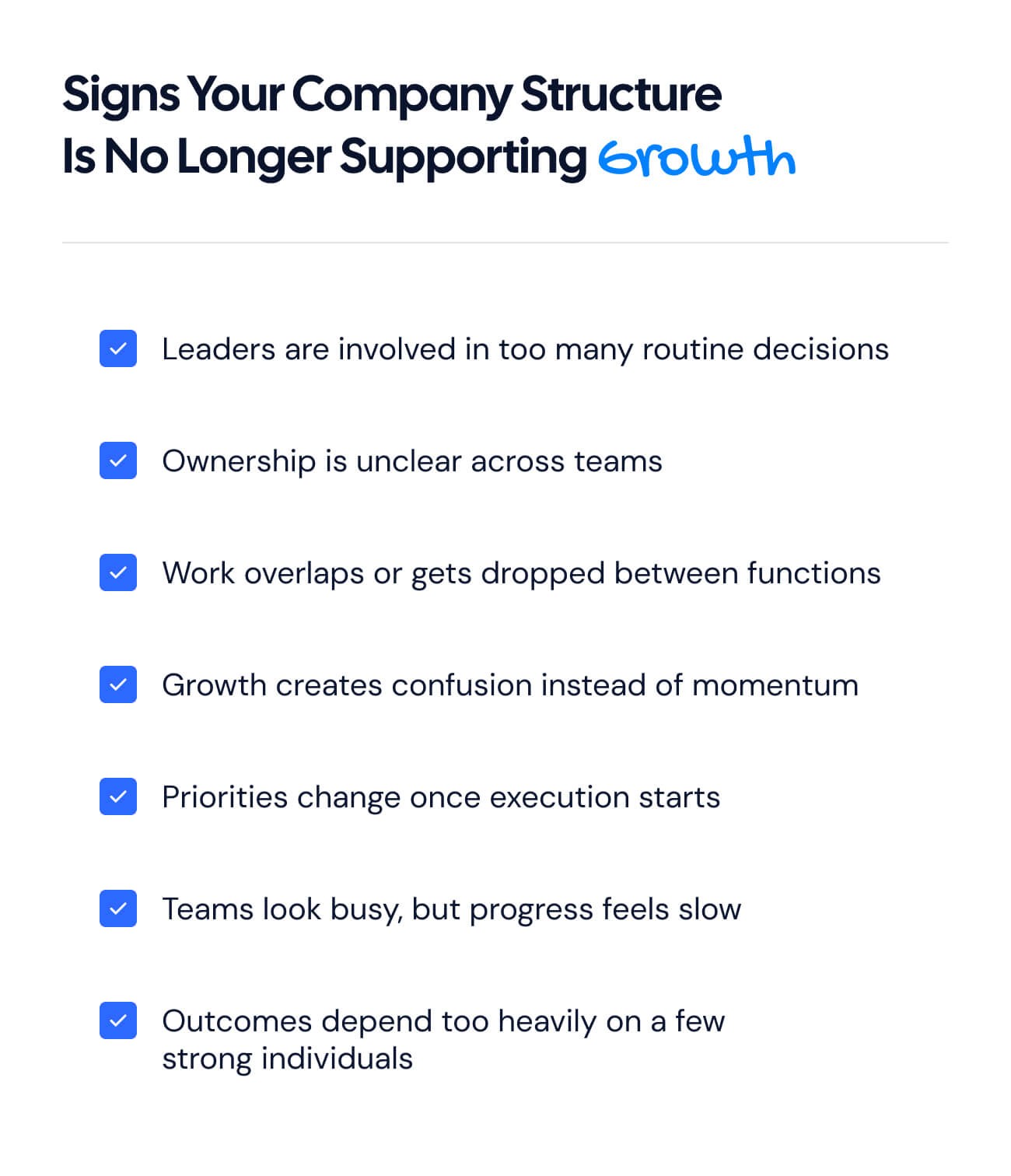
Leaders are still involved in too many routine decisions
Accountability is not clear across teams
Work overlaps or gets dropped between functions
Growth creates more confusion instead of more momentum
Priorities keep changing once they hit execution
Teams look busy, but progress still feels slow
Outcomes depend too heavily on a few strong individuals
One of the clearest patterns is this: the business starts relying on people to compensate for the structure.
That works for a while, especially if the team is strong. But it is not sustainable. At some point, good people stop masking weak design.
The Difference Between Strategy and Structure in Business
Difference between strategy and structure in business: Strategy defines what the business wants to achieve. Structure defines how the business is set up to achieve it.
The reason this distinction matters is simple.
When companies focus only on strategy, they often overestimate how ready the business is to deliver on it. They assume alignment exists because the leadership team is aligned. They assume execution will happen because the priorities are clear.
But clarity at the top does not automatically translate into execution across the company.
That translation needs structure.
It needs a functioning management structure, a clear operational structure, and the right business systems to support it. Otherwise, the strategy stays at the level of intention.
How to Fix Business Structure Issues
How to fix business structure issues: Start by identifying where execution is slowing, where ownership is unclear, and where the organization has outgrown its current operating model.
This is not about restructuring for appearances. It is about fixing the parts of the business that are quietly getting in the way.

A useful starting point is usually this:
Look at where work gets stuck
Not where people say the problem is. Where the work actually slows down.
Where do decisions keep waiting? Where does accountability become fuzzy? Where does cross-functional work start breaking apart?
That is usually where the structural issue is.
Clarify who owns what
A surprising amount of friction comes from basic ownership problems.
People need to know what they are responsible for, what they can decide, and what needs escalation. That alone can improve execution more than many companies expect.
Rebuild governance where needed
If priorities are constantly shifting or decisions are inconsistent, the business probably needs stronger governance.
Not heavier. Stronger.
The goal is not more process. The goal is more clarity.
Make sure the structure matches the stage of the business
A company that is scaling a business cannot keep operating as it did two years earlier.
As the business grows, the structure has to grow with it. If it does not, the gaps start showing up everywhere: in delivery, in decisions, in communication, and eventually in performance.
Final Thoughts
A lot of businesses do not need a new strategy.
They need a structure that can carry the one they already have.
That is usually the harder truth, because it means the issue is not just direction. It is a design. It is how the company is organized, how decisions are made, how accountability works, and whether the business is actually built to support growth.
Strategy matters. Of course it does.
But structure is what gives it a chance to work.
So if your business has a clear direction but execution still feels harder than it should, the issue may not be the strategy itself.
It may be the structure around it.
All In helps businesses strengthen strategy, fix structural friction, and build systems that support long-term performance. If growth is exposing gaps in execution, governance, or alignment, that is usually where the real work starts.
Ready To Go ALL IN?
If your business has outgrown the way it operates, ALL IN can help you redesign the structure, governance, and systems that support growth.