Strategic Consulting
⊹
Business Growth
Leadership Alignment

⊹
TL;DR
A company should consider bringing in a strategic consultant when growth, complexity, or uncertainty starts to exceed its current structure. The right time is usually not when the business is still too early, and not when pressure has already become damage. It is when leadership needs clearer priorities, stronger decision-making, better accountability, and a more practical structure to support the next stage of growth.
Introduction
There is rarely a perfect moment to bring in a strategic consultant.
Some companies consider it too early, when the business is still proving itself. Others wait too long, until the pressure is already visible: decisions slow down, priorities compete, and the leadership team becomes too close to the problem to step back.
The right time usually sits between those two points.
A company should consider strategy consulting when it has enough traction to grow, but enough complexity to need stronger structure. At that stage, the question is no longer only about ambition. It becomes about whether the business is ready to carry its next stage of growth.
For CEOs and leadership teams, the better question is not, “Do we need a consultant?”
It is:
Has the business reached a point where better decisions, clearer priorities, and stronger structure are needed to move forward?
That is where a strategic consultant can create real value.
What Does a Strategic Consultant Do?
A strategic consultant helps leadership teams make clearer decisions about where the business is going, what needs to change, and how growth should be structured.
This can include growth strategy, market expansion, organizational structure, governance, operating models, leadership alignment, and execution planning.
In practical terms, a strategic consultant helps answer questions such as:
Where should the company focus?
Which opportunities are worth pursuing?
What should the business stop doing?
Is the current structure strong enough for the next stage?
Why is execution becoming slower?
Are decisions sitting with the right people?
What needs to change before the company scales further?
The value is not simply in receiving external advice. It is in creating a clearer way for leadership to think, decide, and act.
Good business consulting does not replace leadership judgment. It sharpens it.
A strategic consultant helps with | What this means for leadership |
Growth direction | Deciding where the company should focus next |
Strategic priorities | Separating what matters from what only creates activity |
Decision-making | Clarifying who decides, how decisions move, and what needs escalation |
Organizational structure | Making sure the business is not relying on informal ways of working |
Execution planning | Turning strategy into work the organization can actually carry |
When to Hire a Strategic Consultant

A company should hire a strategic consultant when growth, complexity, or uncertainty starts to exceed the business’s current structure.
This rarely appears as one obvious problem. More often, it shows up through repeated patterns.
A decision takes longer than it should. A project moves without a clear owner. Departments interpret priorities differently. The CEO gets pulled into issues that should no longer need CEO involvement. The company has more activity, but not necessarily more progress.
These signals do not mean the business is failing.
They often mean the company has entered a new stage, but the way it operates has not caught up yet.
This is the space All In often works in: not when a company lacks ambition, but when ambition needs clearer structure, stronger decision-making, and a more disciplined path forward.
Too early | Right time | Too late |
The business is still proving demand | The business has traction, but complexity is increasing | The business is already under serious pressure |
There is not enough operating evidence yet | Leadership needs clearer priorities and stronger structure | Decisions are reactive and problems have already compounded |
Consulting may become theoretical | Consulting can help shape the next stage deliberately | Consulting becomes more about damage control |
Signs Your Company Needs a Consultant
Growth is happening, but it feels harder to manage
Growth can make a company look strong from the outside while making it feel heavier on the inside.
Revenue may be improving. Demand may be there. The team may be working hard. But the business starts requiring more effort to move the same things forward.
You may notice:
More meetings, but fewer clear decisions
More people, but slower execution
More opportunities, but weaker focus
More reports, but less useful insight
More pressure on leadership to keep everything connected
This is one of the clearest signs that business growth consulting may be useful.
The issue is not always a lack of ambition. In many cases, the ambition is already there. What the business needs is a stronger structure behind it.
The CEO or founder is still involved in too many decisions
In the early stage, founder-led decision-making is normal. It is fast, direct, and often necessary.
As the company grows, that same model can become a constraint.
If too many decisions still require the CEO, the business becomes difficult to scale. Teams wait. Leaders hesitate. Priorities depend on access to one person.
The question is not whether the CEO is capable. The question is whether the company has become too dependent on the CEO to move well.
This is where organizational consulting can help. A consultant can support leadership in clarifying decision rights, accountability, governance, and operating rhythms so the business can function without everything flowing through one person.
Leadership agrees on the goal, but not the priorities
Most leadership teams can agree on the big ambition.
Growth. Expansion. Stronger performance. Better market position.
The difficulty usually starts when the team has to decide what comes first.
Sales may want expansion. Operations may want stability. Finance may want control. Marketing may need investment. The CEO may want progress without stretching the organization too far.
These views are not always in conflict. Often, they are all valid. The problem is that they are competing without a clear decision framework.
A business strategy expert can help turn that debate into a structured conversation. The value is not in choosing the loudest priority. It is in helping leadership decide what the business can realistically carry now, what should come later, and what should be stopped.
The company is entering a new market or business line
Expansion is one of the moments where external expertise can be especially valuable.
A new market, region, product line, customer segment, or partnership may look attractive on paper. But expansion decisions create second-order effects. They affect team capacity, cash, operations, brand positioning, and focus.
Before moving forward, leadership needs to pressure-test important questions:
Is this opportunity strategically right, or simply attractive?
What will this expansion require from the current team?
What risks are being underestimated?
How will this affect the core business?
What needs to be built before the move is made?
This is one reason companies hire strategy consultants.
Not because leadership cannot decide, but because the decision is important enough to test properly.
Accountability is becoming unclear
When a company is small, accountability can be informal. People know each other. They speak directly. Problems get solved quickly.
As the business grows, informal accountability starts to break down.
Projects move without clear owners. Teams assume another department is responsible. Senior leaders get pulled into details. Priorities shift without a clear decision process.
The result is not always chaos. Sometimes it looks like constant effort with limited movement.
This is where consulting services can help build the structure behind execution.
Why Timing Matters for Mid-Sized Companies
The need for a strategic consultant often becomes clearer in mid size companies.
At this stage, the company is no longer small enough to run informally. But it may not yet have the systems, governance, or leadership structure of a larger organization.
This middle stage can be difficult.
The company has real traction, real teams, real clients, and real opportunities. But it may still depend on habits from an earlier phase.
That is why consulting for mid size companies is often less about creating a vision from scratch and more about making the business strong enough to carry the vision it already has.
The work becomes practical:
Clarify priorities
Strengthen decision-making
Reduce unnecessary complexity
Improve accountability
Build a structure that supports growth
Help leadership focus on what matters most
This is where the benefits of hiring a business consultant become easier to see. The value is not only external advice. It is helping the company operate with more discipline.
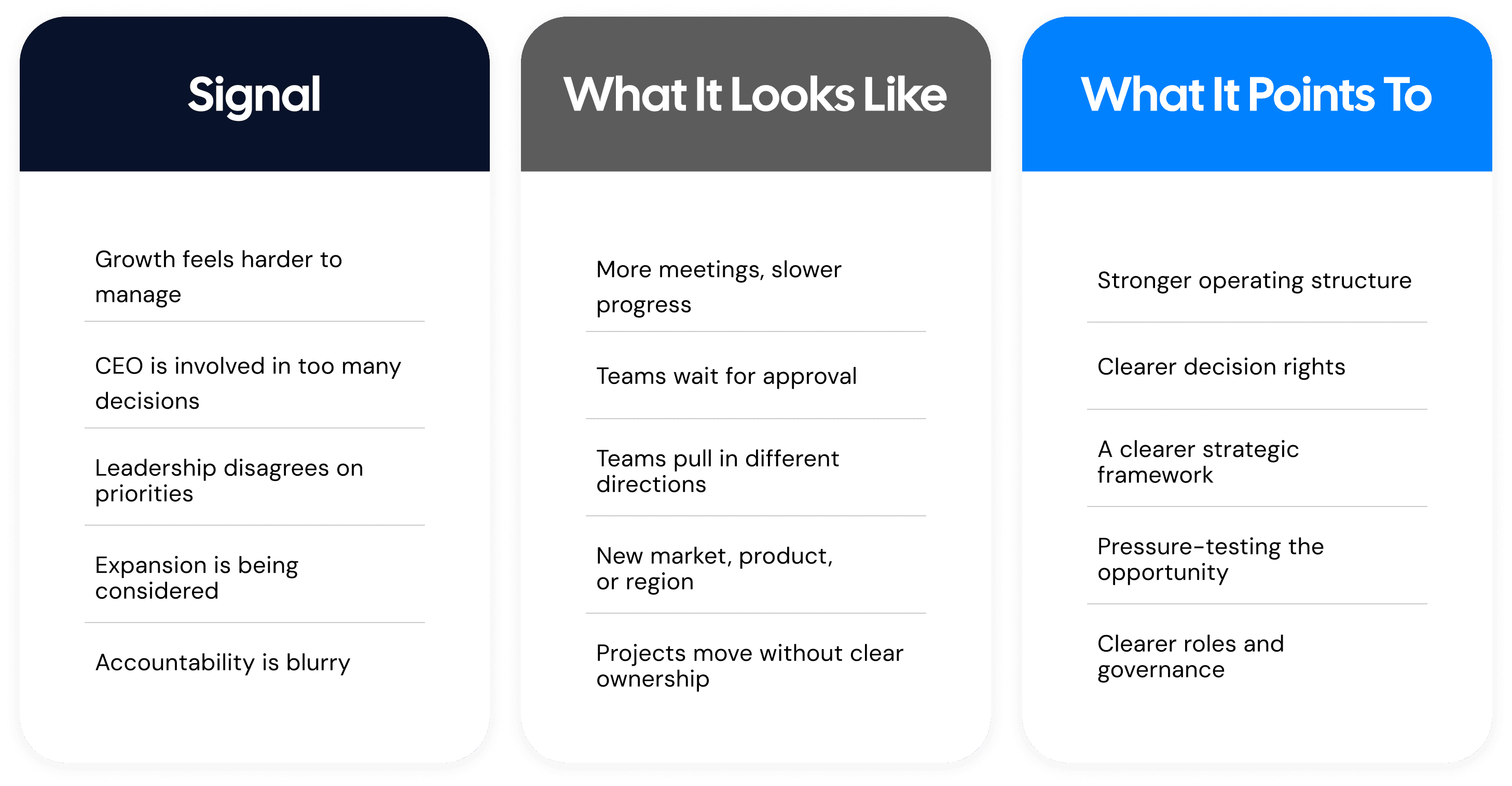
Signal | What it may look like | What it usually points to |
Growth feels harder to manage | More effort, more meetings, slower progress | The business needs stronger operating structure |
CEO is involved in too many decisions | Teams wait for approval or direction | Decision rights are unclear |
Leadership disagrees on priorities | Teams pull in different directions | The company needs a clearer strategic framework |
Expansion is being considered | A new market, product, or region is on the table | The opportunity needs to be pressure-tested |
Accountability is blurry | Projects move without clear ownership | Roles and governance need to be clarified |
When Not to Hire a Strategic Consultant
A strategic consultant is not the right answer for every business problem.
Sometimes the company does not need strategy. It needs stronger sales activity, better execution, tighter financial control, better hiring, or a difficult leadership decision that has been delayed for too long.
Consulting will not fix a problem the company refuses to face.
It is also not useful when leadership has already made a decision and only wants external validation. A good consultant should challenge assumptions. If the company is not open to that, the engagement becomes decoration.
The strongest consulting work happens when leadership is ready to be honest about what is working, what is not working, and what the next stage will require.
How Consultants Help Scale a Business
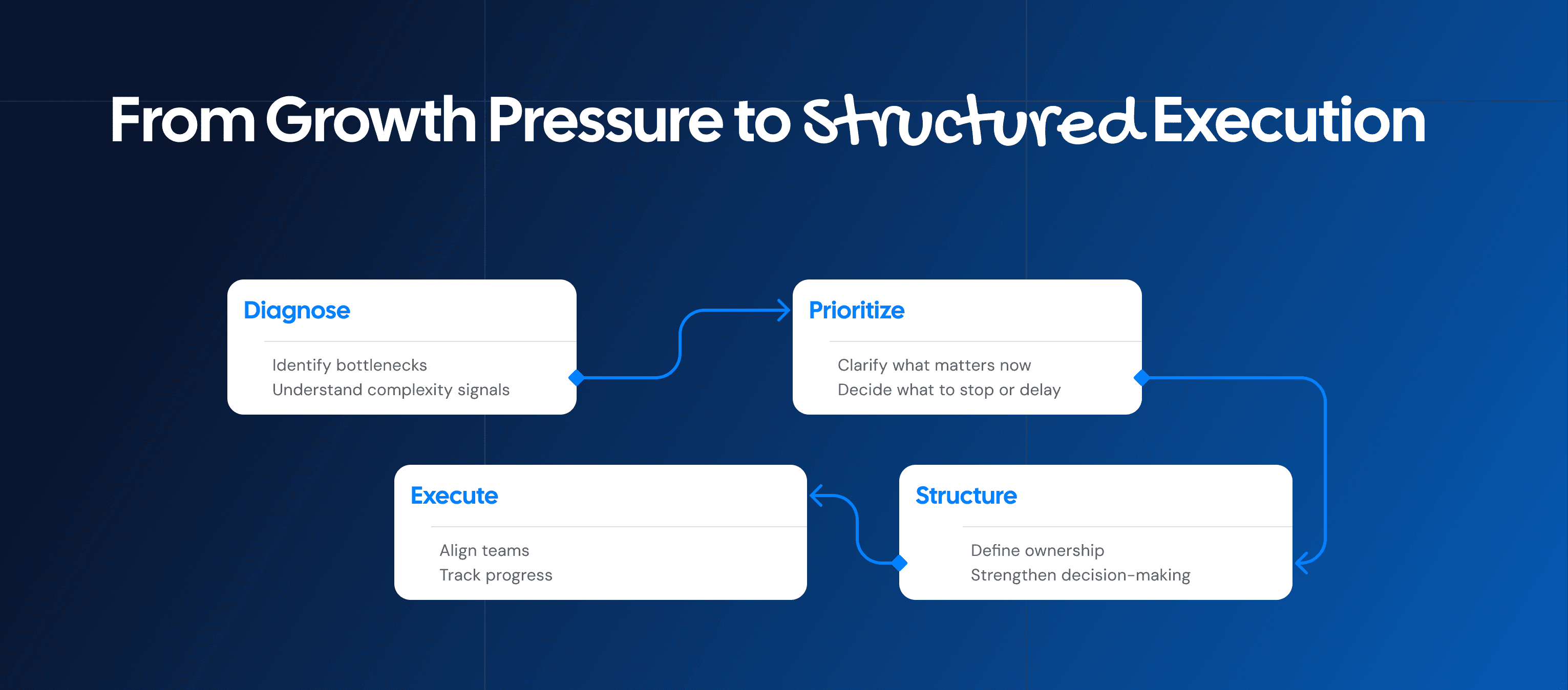
Consultants help scale a business by identifying what needs to change before growth becomes harder to control.
Scaling is not just more revenue, more people, or more markets. It means the business must become better at deciding, aligning, executing, measuring, and adapting.
A strategic consultant can support this by helping leadership:
Define the growth path
Identify bottlenecks
Clarify decision-making
Strengthen the operating model
Align leadership around priorities
Build practical governance
Reduce complexity
Prepare for expansion, investment, or acquisition
The strongest consultants do not only ask, “How can the company grow?”
They ask, “What must be true inside the business for that growth to be sustainable?”
That second question is usually where the real work begins.
How to Choose a Consulting Firm
Choosing a consulting firm should not be based only on reputation, size, or how polished the proposal looks.
The better question is whether the firm understands the real problem the company is trying to solve.
A strong consulting firm should ask sharp questions before offering answers, such as:
What decisions are currently slowing down?
Where is leadership alignment breaking?
What has changed as the company has grown?
Which priorities are competing for the same resources?
Where does execution depend too much on specific individuals?
What will make the next stage harder to manage?
Pay attention to the questions.
Generic questions usually lead to generic work.
What to look for | Why it matters |
Strong diagnostic questions | Shows the firm is trying to understand the real issue |
Clear problem framing | Helps avoid solving the wrong problem |
Practical recommendations | Ensures the work can be used |
Understanding of growth stages | Makes the advice relevant to the company’s reality |
Ability to challenge assumptions | Prevents the engagement from becoming validation only |
Focus on structure and execution | Helps strategy move beyond the presentation stage |
If the real issue is not only growth, but the structure needed to manage it, the choice of consulting partner matters. All In’s work is built around that space: helping leadership teams clarify where they are going, what is getting in the way, and what must be strengthened before the next stage.
A Simple Checklist for CEOs
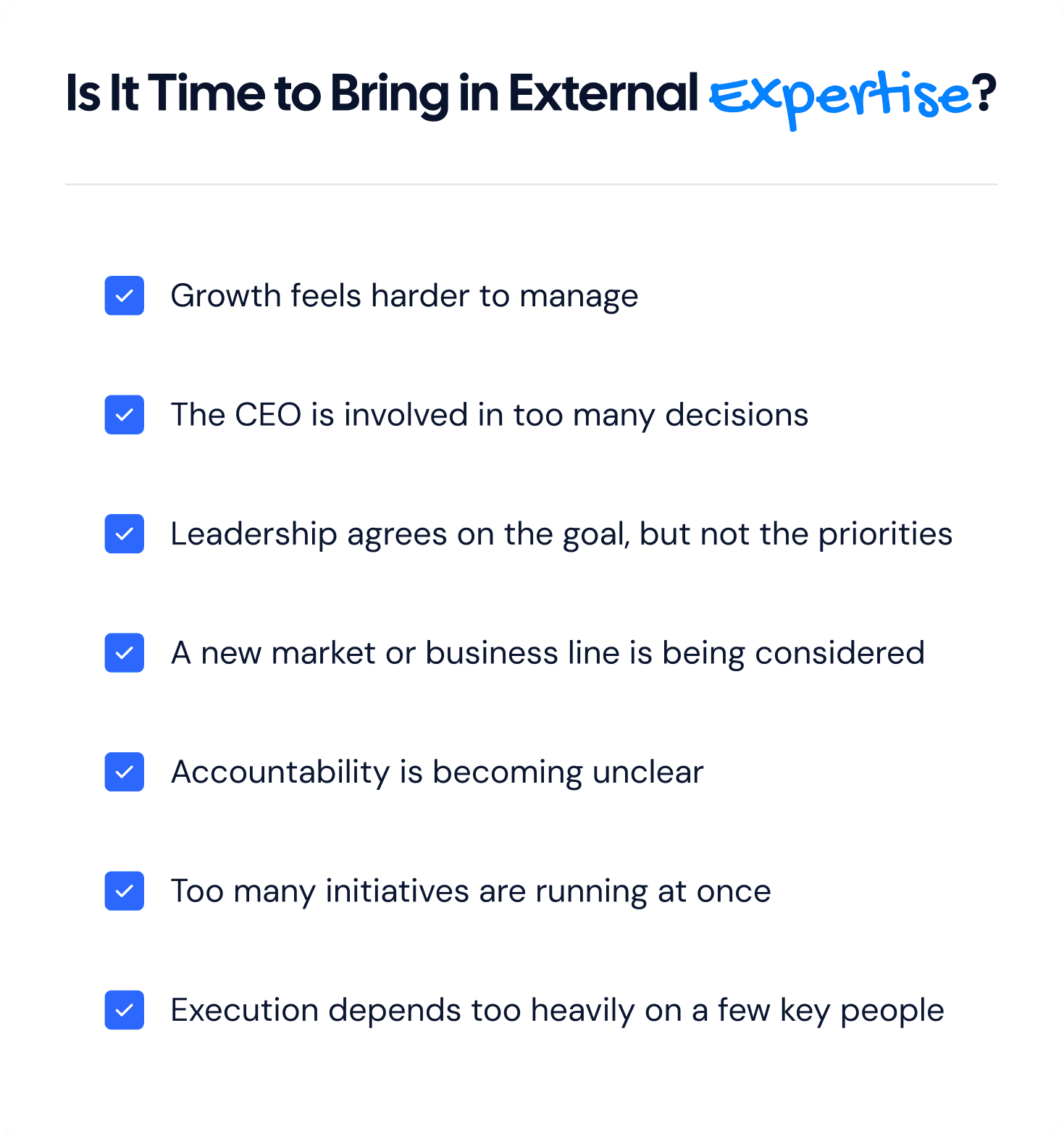
A company may be ready to bring in a strategic consultant if several of these feel familiar:
Growth is happening, but the business feels harder to manage.
Leadership agrees on ambition, but not on priorities.
Important decisions are delayed, repeated, or unclear.
The CEO or founder is still involved in too many decisions.
The company is entering a new market, region, or business line.
Accountability is becoming blurry.
Too many initiatives are running at once.
Execution depends too heavily on a few key people.
The company is preparing for investment, acquisition, or major expansion.
The strategy exists, but the structure behind it is weak.
If three or more of these are true, it may be time to bring in external expertise.
Not because the company is broken.
Because the company may be reaching a stage where the old way of working is no longer enough.
Final Thoughts: Bring in a Consultant Before the Pressure Becomes Damage
The right time to bring in a strategic consultant is not when everything is simple.
It is also not when the business is already under serious strain.
The right time is when leadership can see that the next stage of growth will require clearer priorities, better decisions, and stronger structure than the current model can provide.
That is where consulting can create real value.
At All In, we work with companies when ambition needs structure. We help leadership teams clarify direction, strengthen decision-making, and build the systems needed for sustainable growth.
If your company is starting to feel the weight of its next stage, the first step is understanding what needs to change before more pressure is added.
Ready To Go ALL IN?
If you are aiming for long-term business growth and want your strategy to hold up under real execution, start with a conversation.