Business Clarity
⊹
Strategic Clarity
Decision Making

⊹
TL;DR
Business clarity means people understand the company’s direction, know what matters most, can make decisions using shared criteria, and have clear ownership of results. At All In, we treat clarity as a practical operating system: the structure that converts business strategy into coordinated action.
What Is Business Clarity?
Leaders often ask for more clarity when the real problem is that they haven't made important choices. The team may understand the company vision but still disagree about what matters now, who can make a decision, or who owns the result.
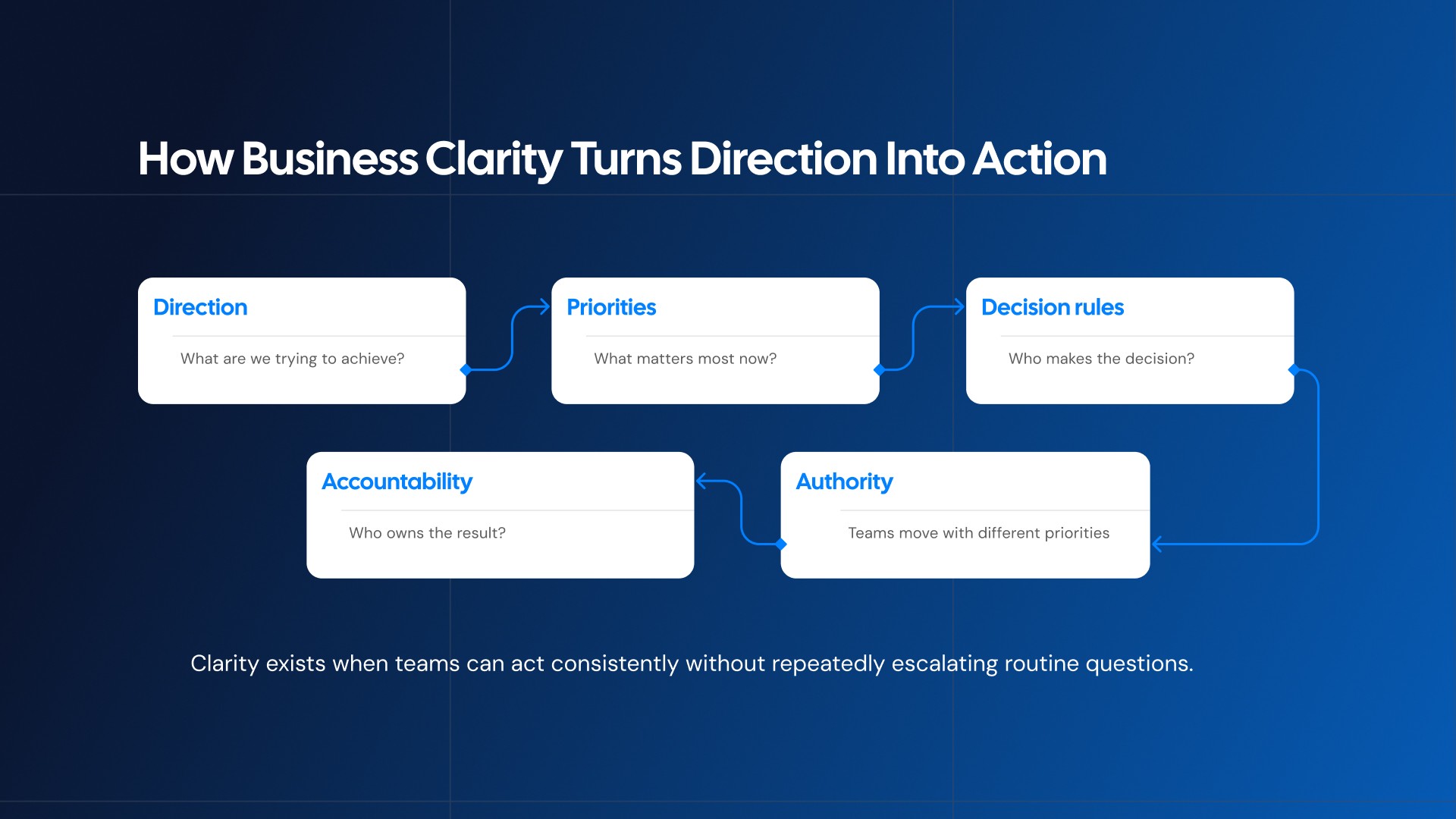
Business clarity exists when people can translate strategic direction into consistent decisions and coordinated action without repeatedly escalating routine questions to senior leadership.
This is where strategic clarity becomes practical: people understand where the company is going and how that direction should guide everyday choices.
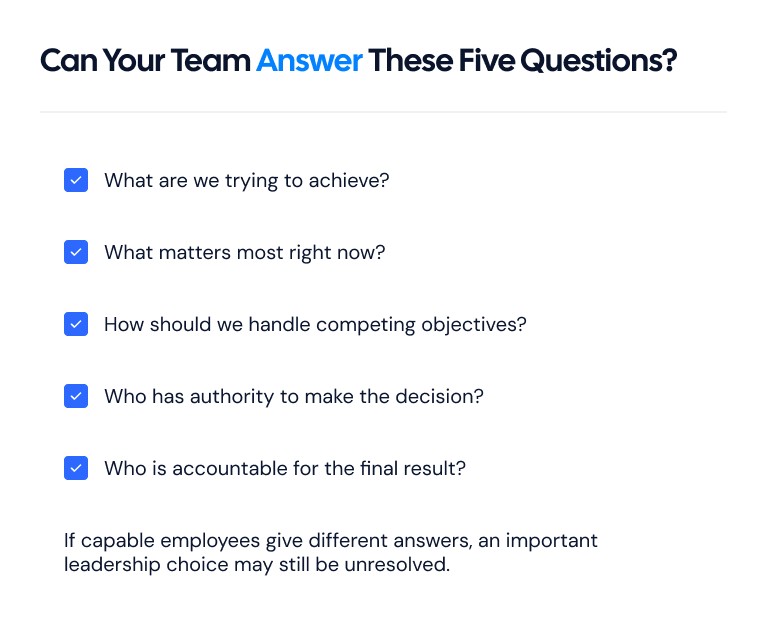
At All In, we use a practical framework to test whether business direction is genuinely usable:
What are we trying to achieve?
What business priorities matter most right now?
How should we handle competing objectives?
Who has the authority to make each decision?
Who is accountable for the final result?
If those questions produce different answers across the company, the organization may have a communication system, but it lacks clarity.
Why Business Clarity Is Often Misunderstood
Clarity is frequently treated as a communication problem. Leaders repeat the strategy, add another meeting, or produce a more detailed presentation. Yet repetition cannot resolve a contradiction.
If employees are told to grow revenue, protect margins, improve quality, and accelerate delivery but aren't told which objective wins when they conflict, they may interpret those priorities differently.
Harvard Business Review explains that, without explicit guidance on trade-offs, managers weigh competing objectives differently and pull the organization in several directions.
Clarity is also easy to confuse with other leadership ideas:
Clarity is not certainty. Leaders can acknowledge uncertainty while still setting a direction.
Clarity is not consensus. Employees can understand a decision without universally agreeing with it.
Clarity is not micromanagement. Teams need clear outcomes, boundaries, and authority, not instructions for every action.
Clarity is not more information. A longer document can make an unresolved choice harder to see.
The Four Components of Business Clarity
Clear priorities
A priority is not simply one item on a long list of important work. It is an explicit ranking.
Employees should know which outcomes matter most now and what to delay, reduce, or stop. Setting clear business priorities requires leaders to name the trade-offs, not merely announce more goals.
Decision rules
Teams need shared criteria for handling competing objectives.
For example, should a product team protect its launch date or delay the release to address a quality concern? “Use your judgment” is only helpful if the company has already defined the boundaries, risk tolerance, and customer commitments that should guide that judgment.
Decision authority
Decision authority includes knowing who recommends, who contributes, who must be consulted, and who makes the final call.
When several executives can reverse a routine decision, employees learn to seek permission instead of exercising judgment. The result is slower decision-making and unnecessary dependence on senior leaders.
Accountability for results
Each important outcome needs a clearly identified owner, an agreed measure, and a review point.
However, accountability without sufficient authority is not genuine accountability. Holding someone responsible for an outcome they cannot influence creates frustration and blame rather than ownership.
Business Clarity vs. Business Strategy
Strategy defines how the business intends to succeed. Business clarity translates that strategy into priorities, decision rights, responsibilities, and measurable outcomes.
Concept | What it answers | Practical output |
Vision | Where are we going? | A shared destination |
Strategy | How will we succeed? | Choices and trade-offs |
Priorities | What matters now? | Ranked outcomes |
Decision clarity | Who decides and how? | Authority and decision criteria |
Accountability | Who owns the result? | One owner and clear measures |
A company can have an ambitious strategy but weak business clarity. The plan may sound compelling, but teams may still be unsure which customers to prioritize, which opportunities to reject, or how to allocate resources.
Strategy establishes the choices. Clarity makes those choices usable throughout the organization.
Signs Your Company Lacks Clarity
Organizational confusion rarely announces itself as a clarity problem. Instead, it appears in everyday operating patterns:
Routine decisions repeatedly move upward for approval.
Departments pursue goals that compete with one another.
Teams duplicate the same work.
Meetings revisit decisions that seemed settled.
Employees describe nearly everything as a priority.
Projects have several stakeholders but no final owner.
Leaders disagree about trade-offs in front of their teams.
People are accountable for results without controlling the resources they need.
A Journal of Management meta-analysis found a negative relationship between role ambiguity and job performance, with variation by job type and rating source.
The practical lesson is not that every role needs a longer description. People need to understand the outcomes and decisions they genuinely own.

A Practical Framework for Creating Business Clarity
Choose one recurring source of delay, disagreement, or escalation. Then work through the following five questions.
1. What are we trying to achieve?
Define the intended outcome in observable terms. Avoid broad descriptions such as “improve performance” or “deliver more value.” Strategic clarity starts with a specific understanding of what the business is trying to achieve.
What would success look like, and how would the team recognize it?
2. What Business Priorities Matter Most Right Now?
Rank the business priorities and state what will receive less attention.
If everything remains equally important, employees are left to interpret competing priorities and make the trade-offs themselves.
3. How should we handle competing objectives?
Establish the principles, criteria, and boundaries that should guide decisions.
For example, a company might prioritize customer safety over launch speed or protect long-term customer retention over short-term revenue.
4. Who has authority to make the decision?
Name one decision-maker and clarify who must be consulted.
Input can come from several people, but the final authority should not remain ambiguous.
5. Who is accountable for the final result?
Assign one owner with enough authority, information, and resources to influence the outcome.
Then define how you will measure the result and when you will review it.
Test the completed framework with a realistic scenario. If two capable employees could follow the guidance and reach completely different conclusions, it is probably still too vague.
This broader principle aligns with McKinsey’s organizational-health research, which highlights strategic clarity, role clarity, and personal ownership as important elements of organizational health.
Some Frequently Asked Questions
What is clarity in business strategy?
Clarity in business strategy means employees understand how the company intends to succeed and can use that direction to make practical choices. It requires more than knowing the company's vision. Teams must understand the priorities, trade-offs, decision criteria, and responsibilities that turn strategy into coordinated work.
How do you create clarity in a company?
Start by defining the desired outcome, ranking current priorities, and making trade-offs explicit. Then establish who has decision authority and who owns the final result. Document these choices in simple language and test them against a real situation to confirm that employees can apply them consistently.
What is the difference between business clarity and business strategy?
Business strategy defines the choices a company makes about how it will compete and succeed. Business clarity makes those choices usable across the organization by establishing priorities, decision authority, responsibilities, and measurable outcomes.
Does clarity mean leaders must have every answer?
No. Clarity is not certainty. Leaders can be transparent about unknowns while still explaining the current direction, immediate priorities, decision boundaries, and conditions that would cause the company to reconsider its approach.
Clarity Is Built Through Explicit Choices
Business clarity does not come from repeating the strategy. It comes from making choices visible and turning them into usable operating rules.
Start with one recurring decision, disputed responsibility, or unclear priority. Apply the five questions and observe whether the team can act with less escalation.
If your team is working hard but losing time to conflicting business priorities or unclear ownership, All In can help turn business direction into practical, coordinated action.
Ready To Turn Strategy Into Action?
Clear priorities and decision rights give your team the direction to move with confidence. ALL IN builds the structures and systems that turn alignment into action.