Decision Making
⊹
Operational Efficiency
Leadership & Governance

⊹
TL;DR
The Problem: Unclear authority causes endless escalations. Routine choices stall, executives waste time on minor details, and employees stop taking initiative.
The Solution
Single Owners: Assign one accountable decision-maker per process.
Risk-Based Authority: Delegate low-risk, reversible decisions; escalate only high-impact financial, legal, or reputational risks.
Hard Time Limits: Set strict response deadlines to eliminate bottlenecks.
Small Start: Reset one high-friction workflow over 30 days before expanding.
Clear chains don't lose control; they protect executive focus and empower teams to act fast.
Why Clear Approval Chains Matter to Business Momentum
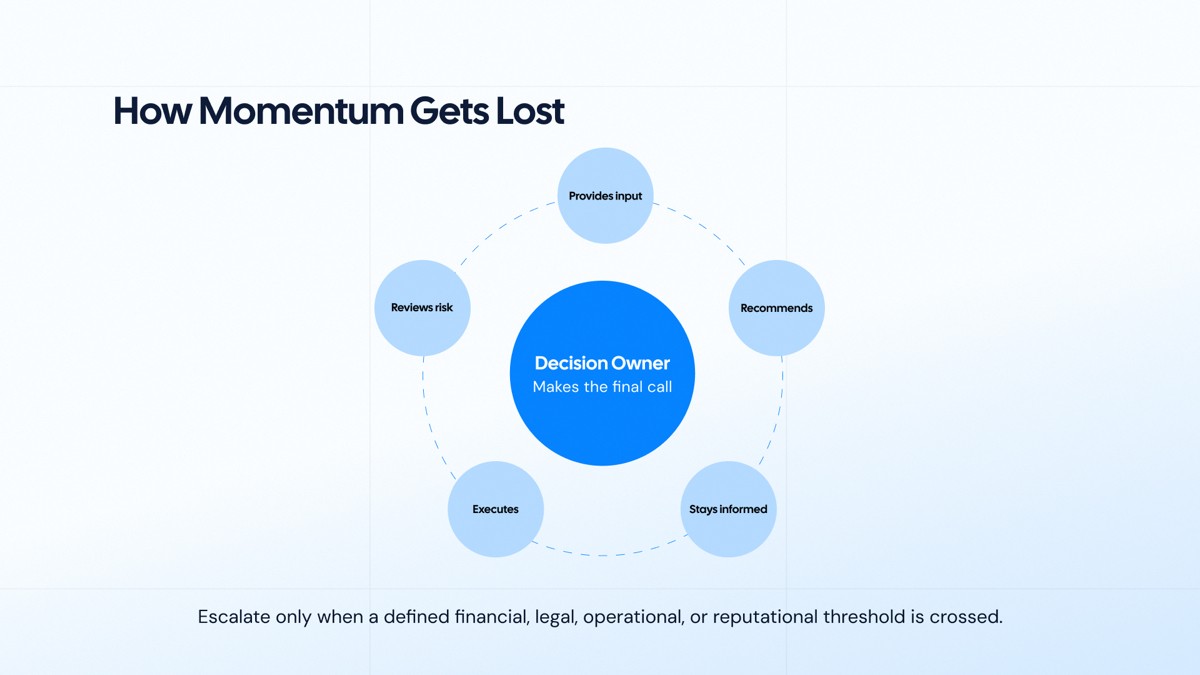
Clear approval chains keep work moving. They define who makes the call, who provides input, and when an issue actually needs to go higher up.
Primary decision-makers own their areas to prevent gridlock. Meanwhile, key stakeholders contribute necessary input without stalling momentum. Leadership steps in only when a decision carries material financial, legal, strategic, or reputational weight.
This balance preserves executive oversight where it matters most, leaving teams free to execute confidently everywhere else.
One delayed campaign may appear harmless, but the same bottleneck repeated across pricing, hiring, purchasing, customer resolutions, and product changes can paralyze an otherwise talented company.
McKinsey research found that only 37% of surveyed respondents believed their organizations consistently made decisions with both quality and speed. That distinction matters: improving speed does not mean abandoning judgment. It means matching the decision process to the actual level of risk.
Warning signs your approval process is failing
Approval problems often hide behind responsible-sounding language. Listen for phrases such as “Let’s get everyone aligned,” “I should run this by leadership,” or “Who owns the final call?”
Other warning signs include:
Routine decisions repeatedly reaching the founder or CEO
Several people holding informal veto power
Meetings ending without a named decision owner
Employees seeking approval after consensus has already been reached
Decisions reopening when a new stakeholder enters the conversation
Low-risk requests following the same process as high-risk commitments
Teams measuring activity while deadlines continue to slip
The clearest diagnostic question is simple: Could two capable employees read the same policy and independently identify who has authority? If their answers differ, the organization does not have a people problem. It has a decision-design problem.
The Hidden Cost of Repeated Escalations
Each escalation creates more than a visible delay. It also imposes switching costs on senior leaders, interrupts execution, and teaches employees to transfer responsibility upward.
Over time, owners become the company’s default decision engine. Their calendar is filled with operational judgments that should have been resolved closer to the work. Meanwhile, strategic priorities receive whatever attention remains.
A common pattern illustrates the problem. A commercial team requests a modest customer concession. Finance reviews the margin, operations reviews delivery, and a department head supports the request, yet nobody knows who can authorize it. The matter reaches the owner, not because it is strategically important, but because the system has no trusted stopping point.
That is how momentum disappears: one defensible escalation at a time.

How to Build Better Business Decision Frameworks
Effective business decision frameworks separate decisions by type, consequence, and reversibility. They do not attempt to document every possible scenario. Instead, they create boundaries that enable sound judgment.
Start with decisions that occur frequently or create repeated delays. Map the current path, identify every handoff, and note where work waits without gaining meaningful insight.
Decision category | Recommended owner | Escalate when | Target timing |
Routine and reversible | Closest qualified team member | A defined limit is exceeded | Same day |
Cross-functional | Named accountable leader | Functions cannot resolve a material trade-off | 24–48 hours |
High-risk or irreversible | Executive or board-level owner | Financial, legal, or reputational exposure is significant | Pre-agreed deadline |
MIT’s decision-making guidance reinforces that every team member should know who will make the decision, how others will contribute, and when it's due.
Then redesign the process around five elements:
One accountable decision owner
Input may come from many people, but one role holds final authority.Explicit thresholds
Set financial, legal, operational, and reputational triggers for escalation.
Time limits
Every approval should have a response deadline and a default next step.
Documented rationale
Record important decisions without turning documentation into another permission layer.
Scheduled review
Revisit authority when roles, strategy, or company scale changes.
This is where many business decision frameworks fail: they define responsibility but ignore behavior. A founder who continues overriding delegated choices will weaken the framework, regardless of what the policy says.
Bain’s decision-role guidance similarly emphasizes distinguishing responsibility for recommendation, input, agreement, performance, and final decision.
A Practical 30-Day Approval Reset
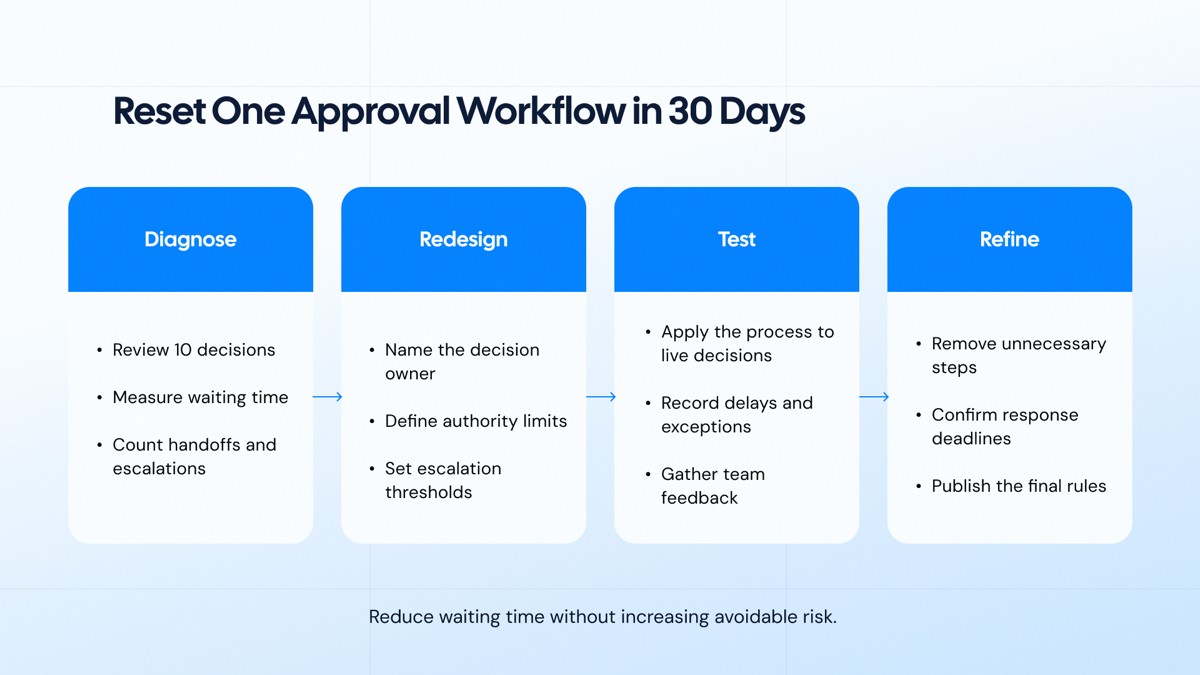
Begin with one high-friction workflow rather than attempting a company-wide redesign.
Start by auditing ten recent decisions in Week 1. Track total elapsed time, active work time, reviewer counts, and escalations. Define single decision owners in Week 2. Set clear risk thresholds for escalations. Test the new process with live decisions in Week 3. Identify any friction points early. Cut unnecessary steps in Week 4. Publish the official rules to finish the reset.
The most useful measure is not the number of approvals removed. It is the reduction in waiting time without an increase in avoidable risk.
If unclear authority reflects a wider operational issue, explore how we approach Strategic Consulting for Sustainable Growth. These resources can help you connect decision speed with the wider systems governing execution.
Conclusion: Give Good People Room to Decide
Clear approval chains do not reduce control. They replace improvised control with visible, proportionate governance.
The best business decision frameworks help owners protect the decisions that truly require their attention while allowing teams to move responsibly without constant permission. The result is faster execution, stronger accountability, and leadership capacity redirected toward growth.
If repeated escalations are consuming your company’s time, we can help you identify where authority breaks down and design a practical system around how your business actually operates. We are here to help you turn stalled decisions into sustained momentum.
Stop Letting Escalations Stall Your Growth
Unclear authority wastes executive time and slows your entire team down. Let's fix your decision framework, eliminate bottlenecks, and get your business moving again.