Operational Excellence
⊹
Scaling Leadership
Business Governance

⊹
TL;DR
Fast-growing companies lose operational control when their people, processes, and decision rights fail to scale with revenue. The answer is not more meetings or closer founder supervision. AllIn helps leadership teams build a lightweight operating system based on meaningful KPIs, explicit governance, reliable management rhythms, and accountable owners.
The central lesson is simple: growth increases complexity faster than most companies increase management capacity.
Why Fast-Growing Companies Lose Operational Control
Operational control provides the visibility needed to drive accountability and address organizational challenges before they become costly. Our performance management services help growing companies establish that visibility through practical systems for accountability, decision-making, and execution..This doesn't mean controlling every decision. It means creating enough visibility and accountability for the company to execute consistently.
During early growth, founders often coordinate the business through proximity. They remain deeply embedded in daily operations, from key client interactions and budget approvals to critical problem resolution. That approach works until the business becomes too complex for one person to manage information and decisions.

Common business growth challenges then appear:
Teams optimize their own targets at the company’s expense
Decisions stall because authority is unclear
Forecasts become unreliable
Meetings produce updates, but few commitments
Problems remain hidden until customers or cash flow are affected
This is rarely a motivation problem. More often, the organization has outgrown an informal performance management system that once worked well.
The Warning Signs of Weak Operational Control
The most revealing warning sign is not a missed target. Instead, it is the operational friction caused by ambiguous accountability and unverified data.
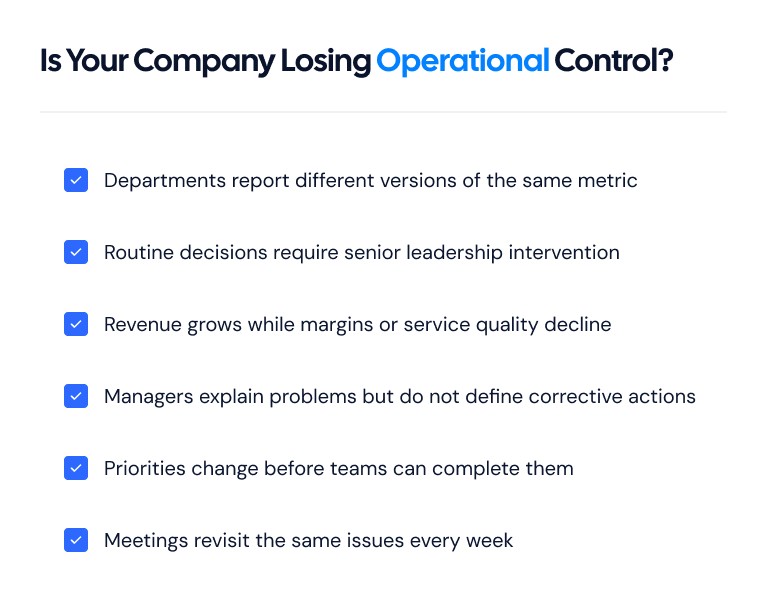
Watch for these indicators:
Different departments report different versions of the same metric
Senior leaders repeatedly intervene in routine decisions
Revenue grows while margins, delivery quality, or retention deteriorate
Managers explain results but cannot identify corrective actions
Priorities change faster than teams can complete them
Meetings revisit the same issues week after week
A practical diagnostic is to ask three people who own a critical outcome. If you receive three answers, or silence, your operational control is weaker than the organization chart suggests.
Rebuild Operational Control With One Management System
KPIs, governance, and meeting rhythms should operate as one connected system. Treating them as separate initiatives creates dashboards nobody trusts, committees nobody needs, and meetings that consume time without improving performance management.
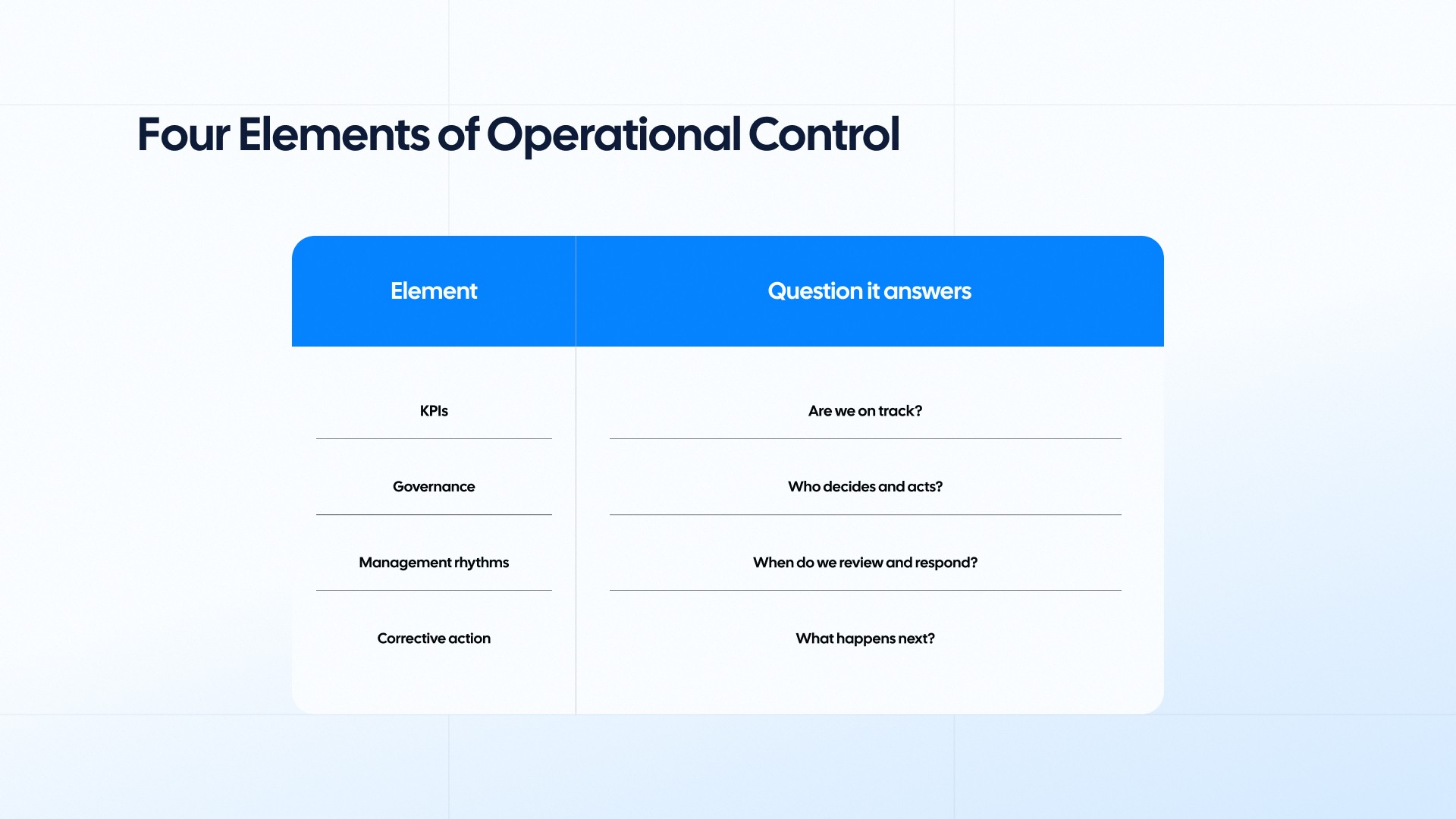
Management element | Question it answers | Practical output |
KPIs | Are we on track? | A small set of leading and lagging indicators |
Governance | Who decides and who acts? | Named owners, thresholds, and escalation rules |
Management rhythms | When do we review and respond? | Weekly, monthly, and quarterly review cycles |
Corrective action | What happens next? | A documented owner, deadline, and expected result |
This reflects ISO’s process approach, in which activities and controls function as an integrated system.
Choose KPIs That Trigger Decisions
Strong operational control does not require dozens of metrics. Most leadership teams need eight to twelve company-level KPIs, supported by more detailed functional measures.
Each KPI should have:
One accountable owner
A precise calculation
A reliable data source
A target and warning threshold
A defined response when performance moves off track
Balance lagging indicators, such as revenue and margin, with leading indicators, such as pipeline coverage, production capacity, onboarding time, or customer-support backlog. Explore how AllIn can help you build an executive KPI dashboard that makes performance visible and actionable. Our guide to building an executive KPI dashboard explains how to make this balance visible.
Clarify Governance and Decision Rights
Governance makes operational control repeatable. Define which decisions belong to executives, functional leaders, and frontline teams, and the conditions that require escalation.
The COSO Internal Control framework provides a useful reference for connecting control environments, risk assessment, information, monitoring, and control activities. For scaling companies, the application can remain lightweight: clear authority, documented exceptions, and proportionate oversight.
A decision-rights framework can prevent founders from becoming the approval layer for every consequential choice.
Install Management Rhythms
Management rhythms convert performance management information into action:
Weekly: Review exceptions, leading indicators, and immediate commitments
Monthly: Examine trends, financial performance, and cross-functional constraints
Quarterly: Reassess priorities, capacity, risks, and resource allocation
Every review should end with a decision, an owner, and a deadline. If a meeting produces only discussion, it is not strengthening operational control.
Board and executive oversight should also align incentives, strategy, and risk management, an emphasis reflected in the G20/OECD Principles of Corporate Governance.
A 30-Day Operational Control Reset
Start small enough to finish:
Days 1–5: Identify the five decisions and five outcomes that matter most
Days 6–10: Assign one owner to each outcome and define decision boundaries
Days 11–15: Confirm KPI formulas, sources, targets, and escalation thresholds
Days 16–20: Launch one weekly operational review
Days 21–30: Remove weak metrics, resolve data disputes, and document actions
Do not begin with new software. First establish the management behavior; then select tools that support it. See our operating cadence guide for a practical meeting structure.
Frequently Asked Question
How can a founder regain control without micromanaging?
A founder regains operational control by defining outcomes, assigning decision rights, and reviewing exceptions rather than supervising every activity. Effective performance management gives leaders visibility while allowing teams to choose how work gets done. The founder intervenes when agreed thresholds are crossed, not whenever a different approach is taken.
Final Thoughts: Build Control That Enables Growth
Operational control isn't meant to slow the company down. It makes speed safer by ensuring information, authority, and accountability keep pace with growth.
If your company faces recurring surprises, unclear ownership, or unproductive management rhythms, start with one critical process and one trustworthy set of KPIs. You do not need a heavier organization; you need a clearer operating system.
At AllIn, we help growing companies identify control gaps, design practical governance, and build a performance management rhythm suited to their stage, making growth more manageable and less fragile.
Ready to Scale Your Operations Without Losing Control?
Stop managing by proximity. Partner with AllIn to build the governance, dashboards, and management rhythms your growing company needs to scale with clarity.