Joint Venture Due Diligence
⊹
Investor Readiness
Financial Reporting

⊹
TL;DR
Investors struggle with joint venture due diligence when legal documents, governance rights, financial records, and operating practices do not align. Resolve these inconsistencies before diligence begins. Clarify ownership and decision rights. Reconcile partner contributions. Define deadlock and exit procedures. Document the ownership or licensing of critical IP. Every material claim should be easy to verify.
Why joint venture due diligence becomes complicated
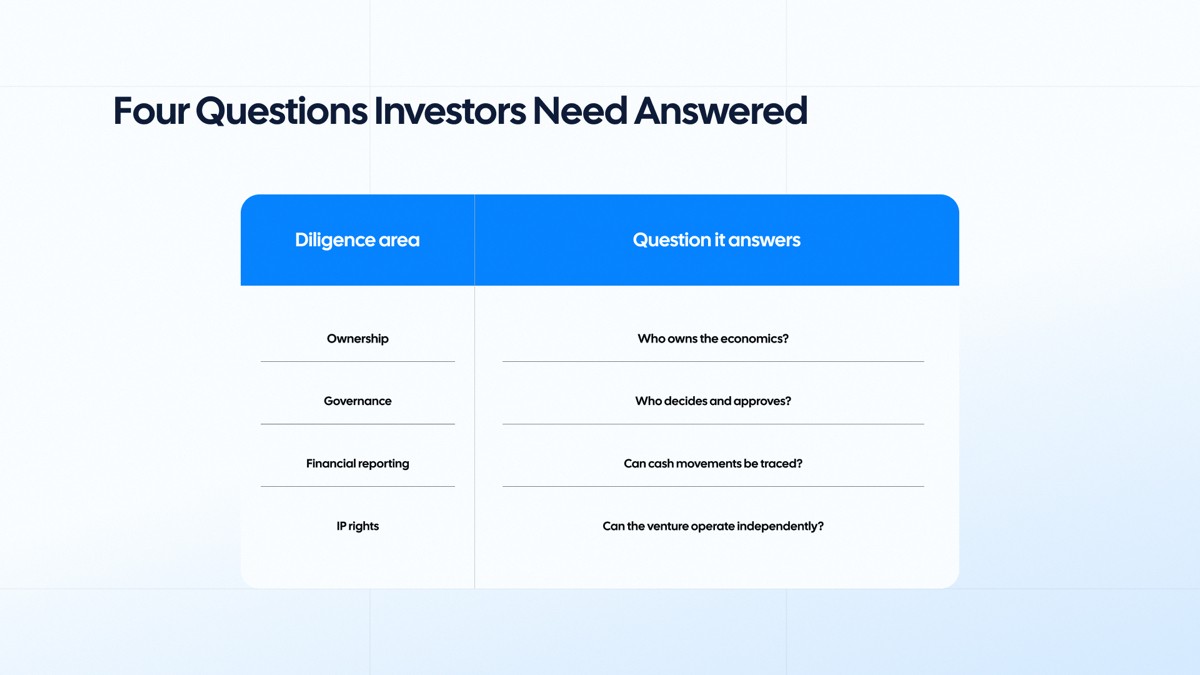
Joint venture due diligence is complex because different partners may own, control, or contribute different parts of the business. For example, a 40% shareholder may provide essential technology, while another partner controls customer relationships or appoints management. Investors need to understand how these roles affect control, dependency, and economic benefit.
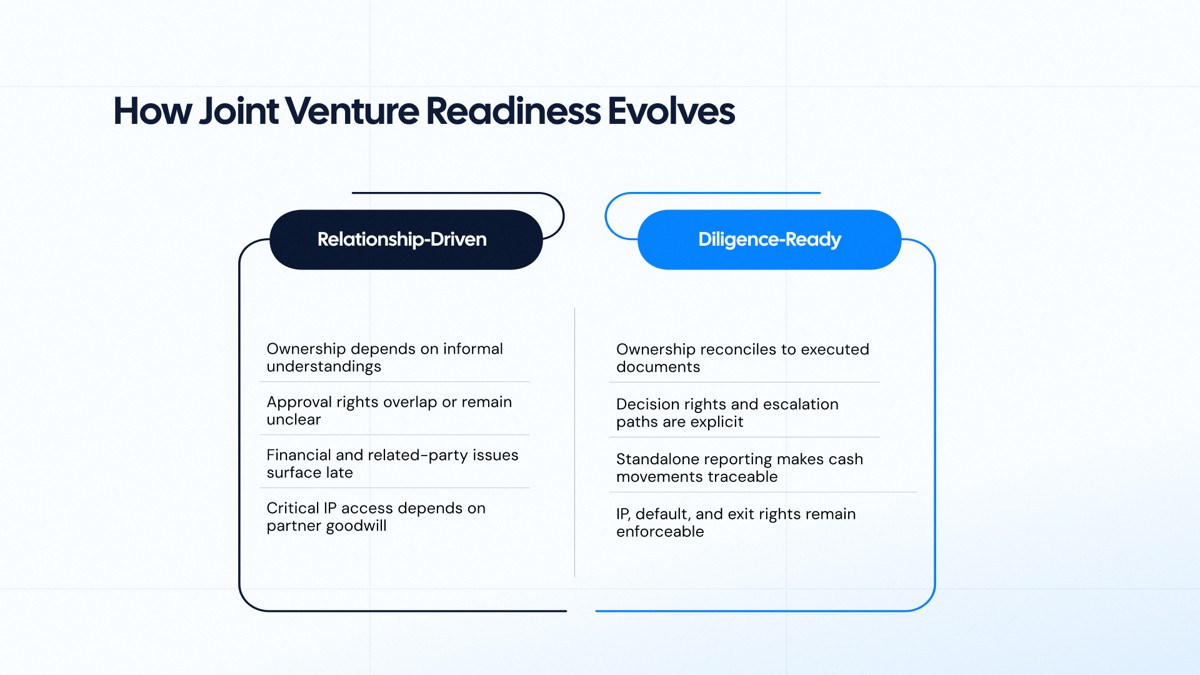
The joint venture governance structure should clearly define how these contributions and dependencies affect decision-making power and control. Otherwise, investors may see the business as too dependent on its partners to operate independently.
Diligence problems often begin when key documents contain conflicting information. For example, the shareholders’ agreement, management accounts, and capitalization table may show different ownership structures. These inconsistencies create more questions and reduce investor confidence.
Start with a single source of truth covering:
Equity ownership, options, warrants, and convertible instruments
Cash and non-cash contributions by each partner
Inter-company loans, guarantees, and service arrangements
Voting rights and board appointment powers
Commercial dependencies on participating firms
Build a joint venture governance structure investors can test
A sound governance framework does more than allocate board seats. It explains how the business makes decisions when the partners disagree, which is a central concern in joint venture due diligence.
Investors will examine which decisions require unanimity, a supermajority, or ordinary board approval. Reserve unanimous consent for fundamental matters, such as issuing new shares or selling the business. If routine budgets, hiring decisions, or customer contracts require every partner’s approval, excessive approval requirements can slow down normal business decisions.
Governance area | Diligence-ready evidence | Investor concern addressed |
Board control | Appointment rights and meeting records | Who controls strategy? |
Reserved matters | Narrow, defined approval schedule | Can one partner obstruct operations? |
Conflicts | Disclosure and recusal procedure | Are related-party decisions independent? |
Deadlock | Escalation, mediation, or buyout mechanism | What happens when partners disagree? |
Exit | Transfer rights and valuation method | Can capital be realized fairly? |
A useful test is to use the signed documents to determine how an unexpected funding request to cover a cash shortfall would be approved and divided among the partners. If the outcome remains unclear, the structure is not ready.
Make ownership and financial reporting reconcile
During joint venture due diligence, investors should be able to trace every ownership interest back to an executed agreement and every material cash movement back to the ledger. The joint venture governance structure should also state who approves budgets, financing, related-party transactions, and distributions.
Create standalone monthly accounts that separately record the joint venture’s income, expenses, assets, liabilities, and cash flows, even when a partner provides finance support. Separate bank accounts, approval limits, cost-allocation policies, and documented intercompany balances make the venture easier to evaluate.
Create standalone monthly accounts that separately record the joint venture’s income, expenses, assets, liabilities, and cash flows, even when a partner provides finance support. Separate bank accounts, approval limits, cost-allocation policies, and documented intercompany balances make the venture easier to evaluate. More broadly, clear financial planning helps connect a business’s operating model with its cost structure and funding requirements, as shown in this financial planning case study.
Accounting treatment also depends on the parties’ substantive rights and obligations, not merely the vehicle’s label. IFRS 11 distinguishes joint operations from joint ventures, while IAS 28 addresses equity-method accounting for qualifying joint ventures.
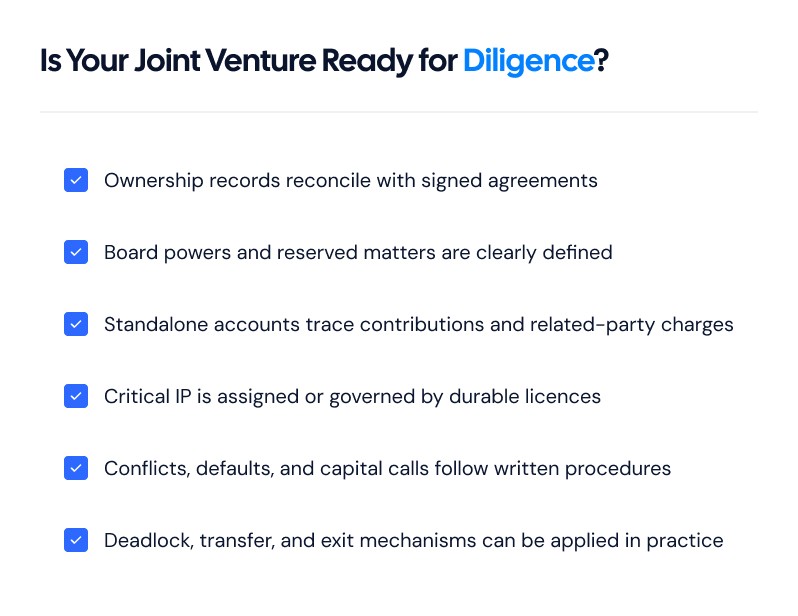
During diligence, investors are likely to compare several key financial and ownership records for consistency. Before opening the data room, reconcile:
The capitalization table to signed securities documents
Management accounts to bank statements
Partner contributions to contractual commitments
Related-party charges to approved pricing policies
Forecast assumptions to operational evidence
Secure intellectual property before joint venture due diligence
In technology-led ventures, weak IP documentation can derail joint venture due diligence even when commercial performance is strong. The venture’s IP agreements and records must clearly distinguish between IP owned by the venture, IP owned by a partner and licensed to the venture, and new IP created through joint activity.
Avoid vague language promising “access” to technology. Licences should define duration, territory, permitted use, exclusivity, sublicensing rights, termination triggers, and treatment after a partner exits.
One recurring risk is dependence on background IP owned by a partner. For example, if the venture’s core product relies on a partner’s software and the licence can be withdrawn after a dispute or change of control, the venture may be unable to continue operating. Investors may therefore view the venture as higher risk and assign it a lower valuation.
Use an IP schedule supported by assignment agreements, licence agreements, contractor terms, and invention records.
Prepare the evidence before the data room opens
The diligence process is less about document volume than document consistency. Your joint venture governance structure should reflect how the business actually operates. Meeting minutes should document key approvals. Contracts and financial records should provide evidence of the venture’s revenue and each partner’s contributions.
Run a mock diligence review from an investor’s perspective. Give each material claim an owner, supporting evidence, and a clear explanation of any exception. Keep an issues log and resolve contradictions before they become formal investor questions.
The strongest ventures are not conflict-free. They are designed to handle conflict without losing control of their assets, finances, or decision-making process.
Turn complexity into investor confidence
Multi-firm ventures can combine capabilities that no participant could build alone. Yet without disciplined joint venture due diligence and a resilient joint venture governance structure, those advantages can become hard-to-price risks.
Preparing your joint venture for investor scrutiny? [Work with All In](https://allin.llc/) to close governance gaps and build a clear, credible diligence case. Contact our team today to make your venture investment-ready.
Preparing your joint venture for investor scrutiny? We can help you close governance gaps and build a credible diligence case. Talk to our team today to make your venture investment-ready.
Ready to Make Your Joint Venture Investment-Ready?
Close governance gaps, streamline due diligence, and present a rock-solid case to investors.